FREE SHIPPING ON ORDERS OVER $99
SECURE CREDIT / DEBIT CARD CHECKOUT
3RD PARTY LAB TESTED - COA AVAILABLE
FOR RESEARCH USE ONLY
SHIPS WITHIN 24 HOURS
JOIN OUR DISCORD FOR GIVEAWAYS!
QUALITY YOU AN TRUST
FREE SHIPPING ON ORDERS OVER $99
SECURE CREDIT / DEBIT CARD CHECKOUT
3RD PARTY LAB TESTED - COA AVAILABLE
FOR RESEARCH USE ONLY
SHIPS WITHIN 24 HOURS
JOIN OUR DISCORD FOR GIVEAWAYS!
QUALITY YOU AN TRUST

—PEER-REVIEWED RESEARCH

Tesamorelin Advanced Growth Hormone Research

Tesamorelin is a synthetic growth hormone-releasing hormone (GHRH) analog currently being investigated for its effects on endogenous growth hormone secretion, body composition, and metabolic health. By stimulating the pituitary gland to increase natural growth hormone release, Tesamorelin supports research involving visceral adipose tissue reduction, lean body mass preservation, and overall metabolic function. As one of the most extensively studied GHRH analogs, Tesamorelin continues to demonstrate promising results across both clinical and preclinical research.

Research Snapshot

CATEGORY

Growth Hormone Research

Mechanism

GHRH Analog

Research

Clinical & Preclinical

Primary Focus

GH Release & Body Composition

Tesamorelin Overview

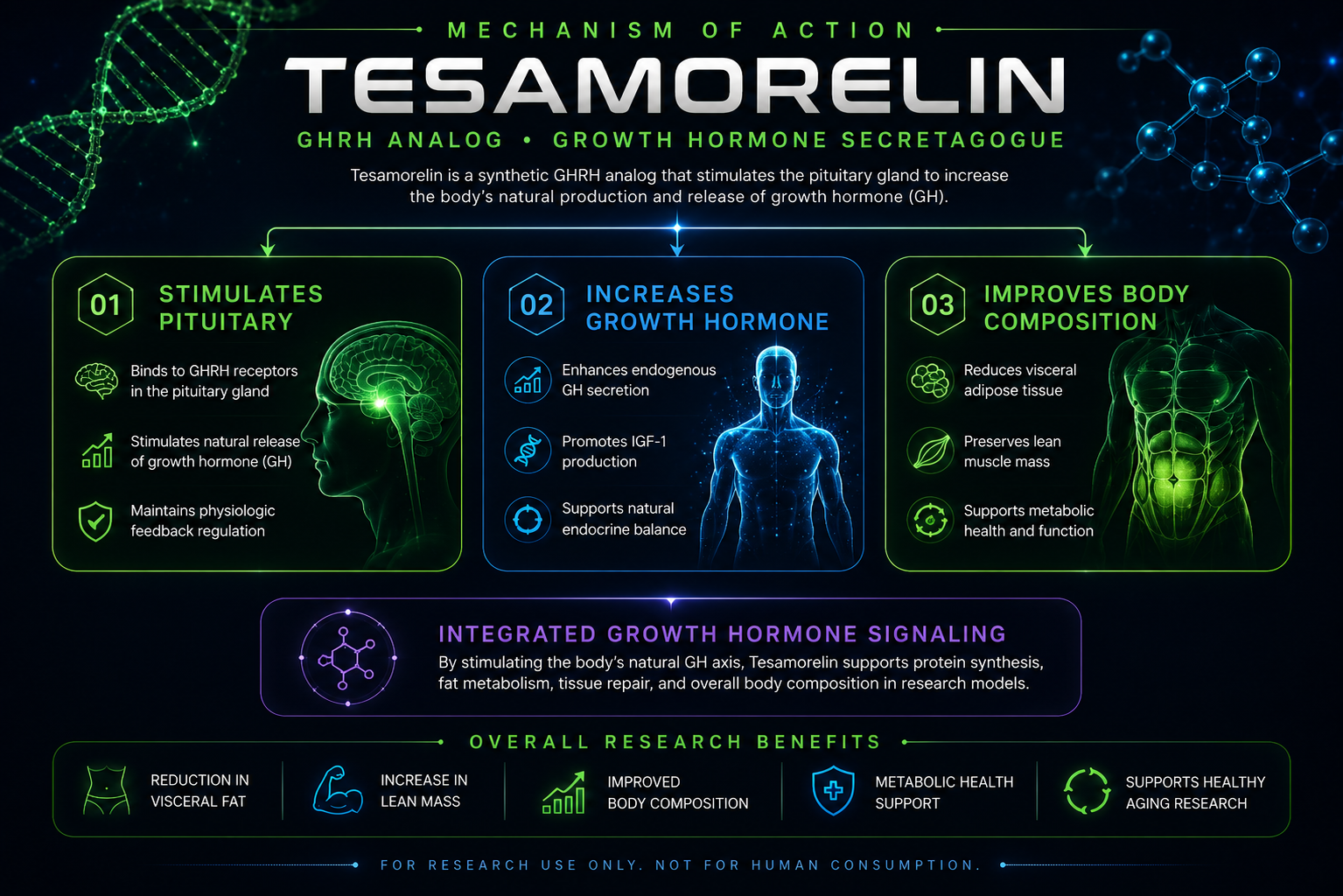
Tesamorelin is a synthetic growth hormone-releasing hormone (GHRH) analog that stimulates the pituitary gland to increase the body’s natural production and release of growth hormone (GH). By mimicking endogenous GHRH, Tesamorelin activates growth hormone signaling through normal physiological pathways, making it one of the most extensively studied growth hormone secretagogues in clinical and metabolic research.


Unlike exogenous growth hormone therapy, Tesamorelin promotes endogenous GH release while maintaining the body’s natural feedback mechanisms. This physiological approach has generated significant scientific interest for its potential effects on visceral adipose tissue, body composition, lean muscle preservation, and metabolic function. Clinical and preclinical studies have demonstrated meaningful reductions in visceral fat together with improvements in several metabolic biomarkers, making Tesamorelin an important investigational compound in endocrine and metabolic research.

Current research continues to explore Tesamorelin’s pharmacology, endocrine signaling, long-term safety profile, and potential applications across body composition, healthy aging, metabolic health, and growth hormone deficiency research. As with all compounds featured in the ChoicePeps Research Library, Tesamorelin is presented for educational and scientific reference purposes only.

Research Highlights

NEW ENGLAND JOURNAL OF MEDICINE

Landmark Phase III Clinical Trial Demonstrating Significant Reductions In Visceral Adipose Tissue Together With Improvements In Lipid Profiles Following Tesamorelin Therapy.

JOURNAL OF CLINICAL ENDOCRINOLOGY & METABOLISM

Randomized Placebo-Controlled Trial Demonstrating Sustained Visceral Fat Reduction, Increased IGF-1 Levels, And Long-Term Safety Of Tesamorelin.

JAMA

Clinical Trial Evaluating Tesamorelin's Effects On Visceral Adipose Tissue And Liver Fat, Demonstrating Significant Improvements In Body Composition And Hepatic Fat Content.

ENDOCRINE & METABOLIC RESEARCH

Comprehensive Clinical Research Examining Tesamorelin's Effects On Growth Hormone Secretion, IGF-1 Production, Body Composition, And Metabolic Health.

Research Applications

Current preclinical and clinical research is investigating Tesamorelin across several important areas of endocrinology, growth hormone physiology, body composition, and metabolic health.

🧠
Growth Hormone Stimulation
  • Endogenous GH secretion
  • Pituitary GHRH receptor activation
  • Physiologic GH release
  • IGF-1 production
💪
Body Composition
  • Lean muscle preservation
  • Visceral fat reduction
  • Protein synthesis research
  • Body composition analysis
Metabolic Health
  • Lipid metabolism
  • Energy utilization
  • Metabolic biomarkers
  • Overall metabolic function
❤️
Endocrine Research
  • Growth hormone axis
  • IGF-1 signaling
  • Hormonal regulation
  • Endocrine physiology
🔬
Future Clinical Research
  • Healthy aging research
  • Metabolic disorders
  • Body composition optimization
  • Expanded endocrine applications
📈
Ongoing Investigation
  • Long-term safety evaluation
  • Visceral adipose tissue research
  • Growth hormone physiology
  • Metabolic health outcomes

— FAQ

Questions, answered.

If you don’t see what you’re looking for, reach our team directly — usually under 24 hours.
01What is Tesamorelin?

Tesamorelin is a synthetic growth hormone-releasing hormone (GHRH) analog that stimulates the pituitary gland to increase the body’s natural production of growth hormone (GH). Unlike growth hormone replacement therapy, Tesamorelin works by activating the body’s own endocrine signaling pathways, making it an important investigational compound in endocrinology and metabolic research.

Tesamorelin binds to GHRH receptors located in the anterior pituitary gland, triggering the release of endogenous growth hormone. Elevated GH levels subsequently stimulate the production of insulin-like growth factor-1 (IGF-1), a key mediator involved in tissue growth, metabolism, body composition, and cellular repair. This physiologic mechanism preserves the body’s natural hormonal feedback system.

Researchers are interested in Tesamorelin because it increases endogenous growth hormone secretion without administering growth hormone directly. Clinical studies have demonstrated reductions in visceral adipose tissue, preservation of lean body mass, and improvements in several metabolic biomarkers, making it a valuable compound for studying body composition, endocrine function, and metabolic health.

Tesamorelin has been evaluated in numerous preclinical and clinical studies, including randomized Phase III trials published in leading medical journals such as the New England Journal of Medicine and the Journal of Clinical Endocrinology & Metabolism. Research has examined its effects on visceral adipose tissue, growth hormone secretion, IGF-1 levels, metabolic function, and long-term safety.

Tesamorelin primarily targets growth hormone-releasing hormone (GHRH) receptors located on pituitary somatotroph cells. Activation of these receptors stimulates the physiologic release of endogenous growth hormone, initiating downstream endocrine signaling that includes increased IGF-1 production and regulation of multiple metabolic processes.

Tesamorelin has received FDA approval for a specific medical indication under physician supervision. The Tesamorelin featured in the ChoicePeps Research Library is presented exclusively for educational and scientific reference purposes and is intended for laboratory research only. It is not intended for human consumption or therapeutic use.

  • Current research continues to investigate Tesamorelin’s effects on growth hormone physiology, visceral adipose tissue reduction, body composition, lean muscle preservation, metabolic health, healthy aging, and endocrine regulation. Ongoing studies are also evaluating long-term safety, hormonal signaling pathways, and additional research applications involving the growth hormone/IGF-1 axis.
⚠️ Scientific Disclaimer

The information presented in the ChoicePeps Research Library is provided solely for educational and informational purposes. Content is compiled from publicly available scientific literature and is intended to summarize current areas of research involving investigational compounds.

The material presented on this page has not been evaluated by the U.S. Food and Drug Administration (FDA) and should not be interpreted as medical advice, treatment recommendations, or evidence of clinical efficacy. Scientific understanding continues to evolve as additional laboratory and clinical research becomes available.

ChoicePeps does not make claims regarding the diagnosis, treatment, cure, or prevention of any disease. Visitors are encouraged to consult original peer-reviewed publications when reviewing scientific findings.

FOR RESEARCH USE ONLY

Products offered by ChoicePeps are intended exclusively for legitimate laboratory and scientific research. They are not intended for human or veterinary use, and they are not intended for use in the diagnosis, treatment, cure, or prevention of any disease.