
How to Read a Peptide COA: Understanding Identity, Purity & Content
What Is a Peptide COA?
A peptide Certificate of Analysis, or COA, is a laboratory report that documents the results of testing performed on a specific sample or batch.
For peptide research products, a COA may include results such as identity, purity, and measured content. These results answer different questions, so it is important to understand what each test actually shows rather than relying on a single number.
At ChoicePeps, our currently shipping COAs are used to document the testing performed on specific product batches and allow researchers to match a vial’s batch number to the corresponding laboratory report.
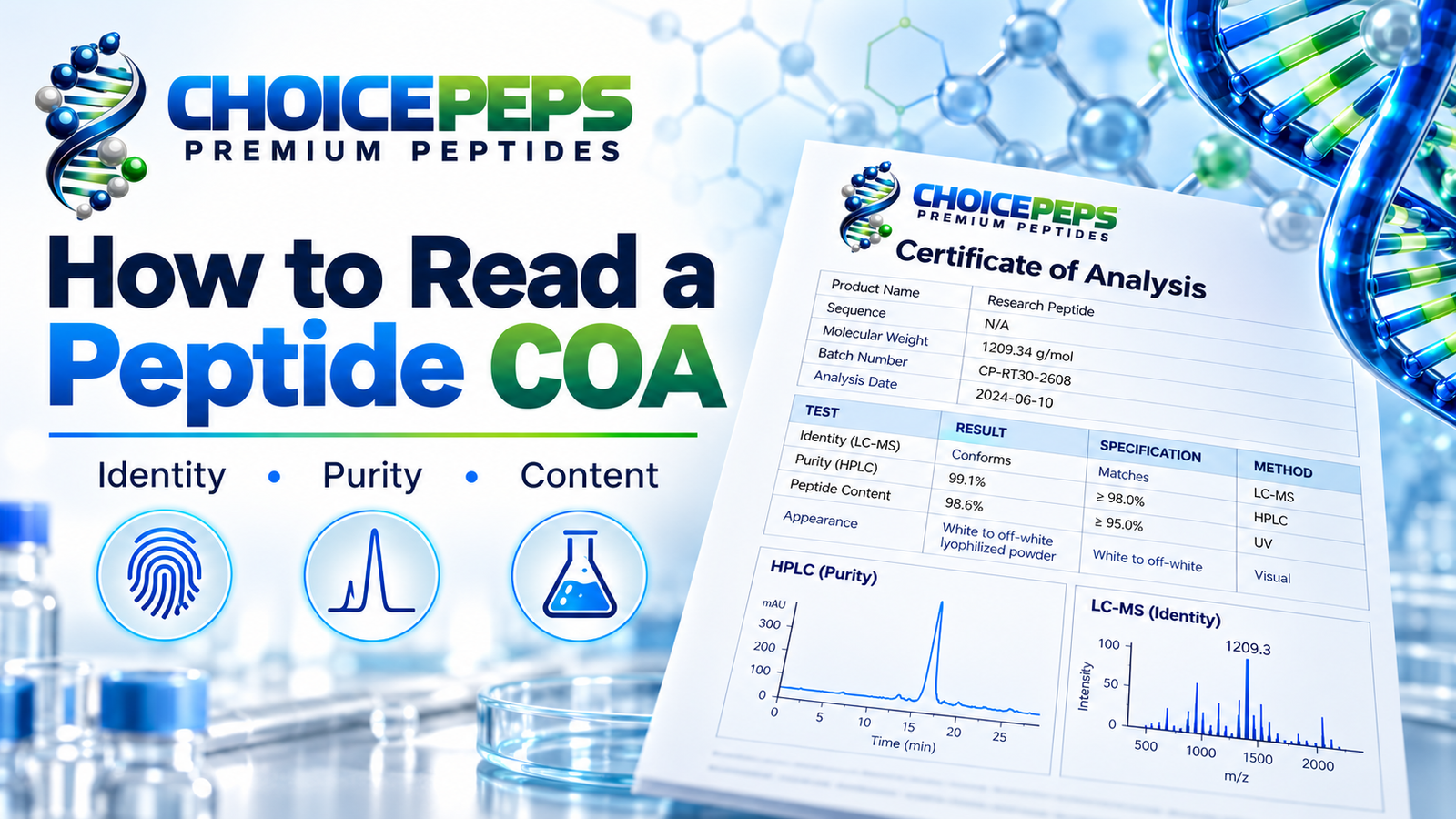
A peptide COA should be read as a collection of individual test results. Identity, purity, and content answer different questions, and no single result should be interpreted as establishing everything about a tested sample.
60-Second Peptide COA Checklist
Use this quick checklist when reviewing a peptide COA. It helps confirm that you are looking at the correct report and shows which testing details are actually documented.
- Match the batch number: Confirm the batch or lot on the vial corresponds with the batch or identifying information on the report.
- Check the product or sample name: Make sure the report identifies the compound you intended to review.
- Look for identity testing: Confirm that the report includes an identity result showing the tested sample was consistent with the stated compound under the laboratory method used.
- Review purity and the analytical method: Do not rely only on a headline percentage. Look at the reported purity result and the method used to obtain it.
- Compare content or quantity: Review how much target peptide was measured and compare that result with the labeled amount where applicable.
- Check the report details: Look for the laboratory name, report date, accession number, search code, or other identifying information provided by the lab.
- Note which tests were not performed: Identity, purity, and content do not automatically establish sterility, endotoxin levels, or other characteristics unless those tests are specifically included on the report.
The Three Main Results on a ChoicePeps COA
| Test | What It Helps Answer |
|---|---|
| Identity | Is the tested sample consistent with the stated compound? |
| Purity | What proportion of the detected material is attributed to the target peptide under the laboratory method used? |
| Content / Quantity | How much of the target peptide was measured in the tested sample? |
1. Identity
Identity testing is used to determine whether the tested sample is consistent with the peptide it is supposed to contain, within the capabilities of the laboratory method being used.
In simple terms, identity answers the question: “Is this the compound the label says it is?”
This is important because purity alone does not establish identity. A sample could produce a high purity result, but the laboratory still needs an appropriate analytical procedure and validation approach for the characteristic being evaluated.
2. Purity
Purity describes the proportion of the detected material attributed to the target peptide under the specific analytical conditions used by the laboratory.
A result such as 99% purity does not mean that the vial has been proven to be “99% free of every possible contaminant.” Purity testing reflects what is detected and measured by the particular analytical method used.
That distinction matters because different tests answer different questions. Purity testing is useful, but it should not be interpreted as a sterility test, endotoxin test, or universal contamination screen.
3. Content / Quantity
Content, sometimes described as quantity, reports how much of the target peptide was measured in the tested sample according to the laboratory’s method.
For example, if a product is labeled as containing 10 mg, the content result helps show how much peptide the laboratory actually measured in the submitted sample.
This is different from purity. A sample can have a high purity percentage while still containing more or less total peptide than the stated amount, which is why both measurements provide useful information.
What a Peptide COA Does Not Tell You
A COA is only as broad as the testing performed. Identity, purity, and content provide useful information about a tested sample, but they do not answer every possible quality question.
A high purity result does not automatically mean that a sample has passed sterility testing, endotoxin testing, or every other type of contaminant analysis.
For example, a purity result does not automatically establish sterility, and it does not show whether endotoxins were present unless bacterial endotoxin testing was specifically performed.
Likewise, identity testing confirms consistency with the expected compound within the capabilities of the analytical method, but it does not replace other specialized testing that may be needed to evaluate different characteristics of a sample.
This is why it is important to read the individual COA and look at the specific tests that were actually performed rather than relying only on a headline purity percentage.
How to Match a Vial to the Correct Peptide COA
Peptide COAs should be matched to the specific batch or lot associated with the vial being reviewed. A report for a different batch does not automatically represent every vial of the same product.
At ChoicePeps, each vial is labeled with a batch number. That batch number can be used to locate the corresponding laboratory report.
Step 1: Find the Batch Number on the Vial
Look for the batch number printed on the product label. This identifier is used to connect the vial to its specific testing record.
Step 2: Check the Currently Shipping COAs
For products that are currently being shipped, visit the Currently Shipping COAs page and locate the matching product and batch number.
Step 3: Use the Full Batch Ledger for Historical Lots
If the batch is no longer part of the currently shipping inventory, use the Full Batch Ledger to search past and retired lots.
Step 4: Verify the Report Through the Testing Laboratory
When available, researchers can also verify ChoicePeps reports through the testing laboratory’s own records. Freedom Diagnostics provides a public Certificate of Analysis Lookup that can be searched by company name, Search Code, or accession number.
Using both the ChoicePeps batch records and the laboratory’s independent lookup provides another way to confirm that the COA being reviewed corresponds to the intended testing record.
How to Read a Peptide COA Lab Report
Once you have matched the batch number on the vial to the correct COA, review the report itself rather than focusing on only one result.
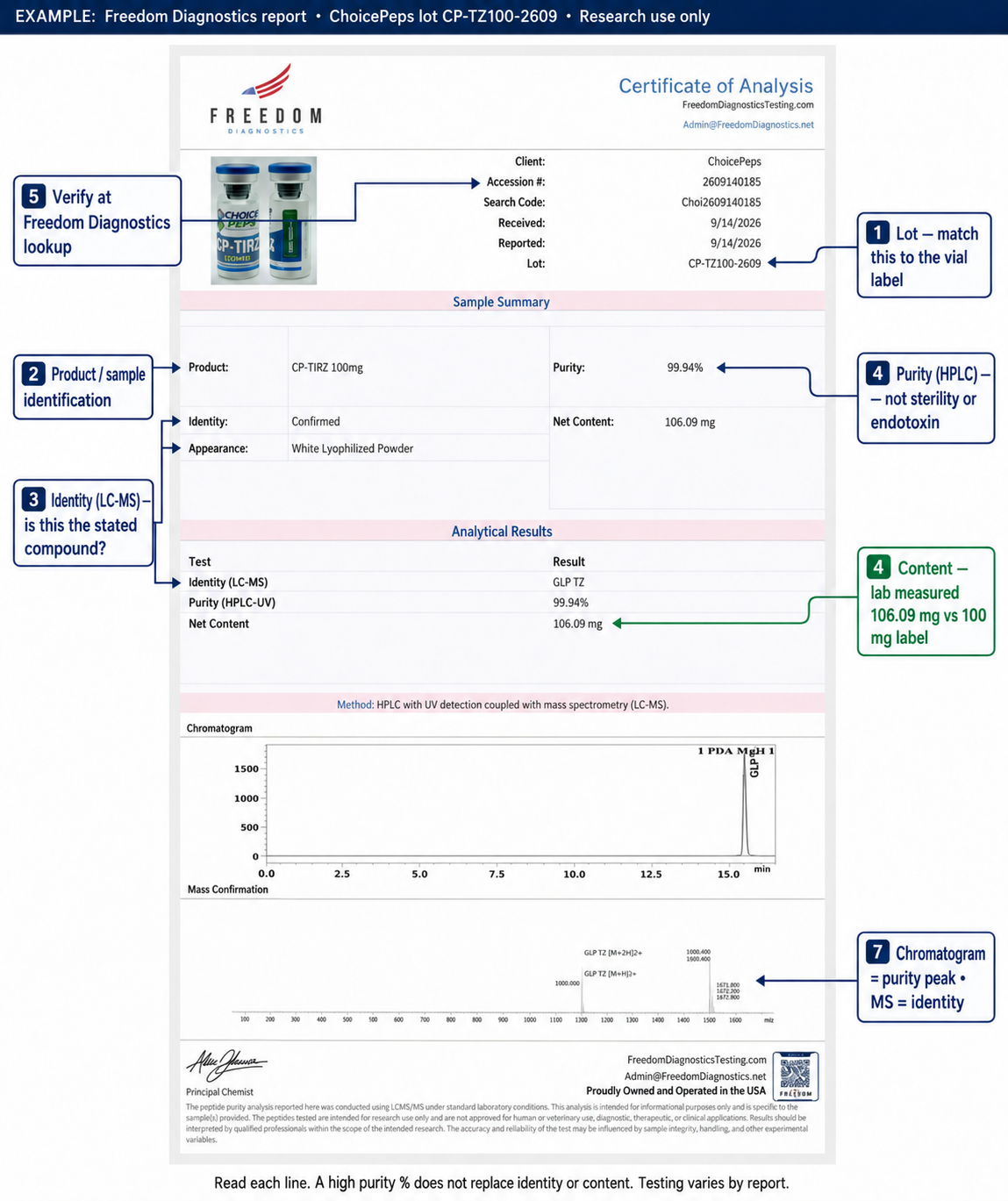
Check the Sample or Product Identification
Confirm that the sample name or product identification on the report matches the product you are reviewing. This helps establish that you are looking at the intended test record.
Confirm the Batch or Lot Information
Compare the batch or lot number shown on the report with the batch number printed on the vial. These should correspond to the same tested batch.
Review the Identity Result
Look for the portion of the report that documents identity testing. This indicates whether the tested sample was consistent with the expected compound according to the laboratory method used.
Review the Purity Result
Locate the reported purity percentage and any chromatogram or related analytical data included by the laboratory. Remember that purity reflects the analytical method used and should not be interpreted as a sterility or endotoxin result.
Review the Content or Quantity Result
Check the reported content or quantity to see how much of the target peptide was measured in the submitted sample. Compare this result with the labeled amount where applicable.
Check the Laboratory and Report Details
Review the laboratory name, report date, sample identification, accession or search code when provided, and any other report-specific information. These details help establish which sample was tested and when the analysis was performed.
For reports issued by Freedom Diagnostics, the laboratory’s public COA lookup can also be used to locate the corresponding laboratory record.
Why Batch-Specific Testing Matters
Peptide testing is most useful when the laboratory report can be tied to a specific batch or lot. A COA for one batch should not automatically be assumed to represent every future batch of the same product.
Batch-specific testing gives researchers a clearer way to review the analytical results associated with the actual lot being evaluated. It also makes historical records more meaningful because current and retired batches can be distinguished from one another.
At ChoicePeps, batch numbers are used to connect product labels with their corresponding laboratory reports so researchers can review the testing associated with a specific lot.
Review ChoicePeps COAs and Batch Records
Check the laboratory reports associated with currently shipping ChoicePeps batches, or search historical and retired lots using the full batch ledger.