FREE SHIPPING ON ORDERS OVER $99
SECURE CREDIT / DEBIT CARD CHECKOUT
3RD PARTY LAB TESTED - COA AVAILABLE
FOR RESEARCH USE ONLY
SHIPS WITHIN 24 HOURS
JOIN OUR DISCORD FOR GIVEAWAYS!
QUALITY YOU AN TRUST
FREE SHIPPING ON ORDERS OVER $99
SECURE CREDIT / DEBIT CARD CHECKOUT
3RD PARTY LAB TESTED - COA AVAILABLE
FOR RESEARCH USE ONLY
SHIPS WITHIN 24 HOURS
JOIN OUR DISCORD FOR GIVEAWAYS!
QUALITY YOU AN TRUST

—PEER-REVIEWED RESEARCH

Cagrilintide Advanced Amylin Research

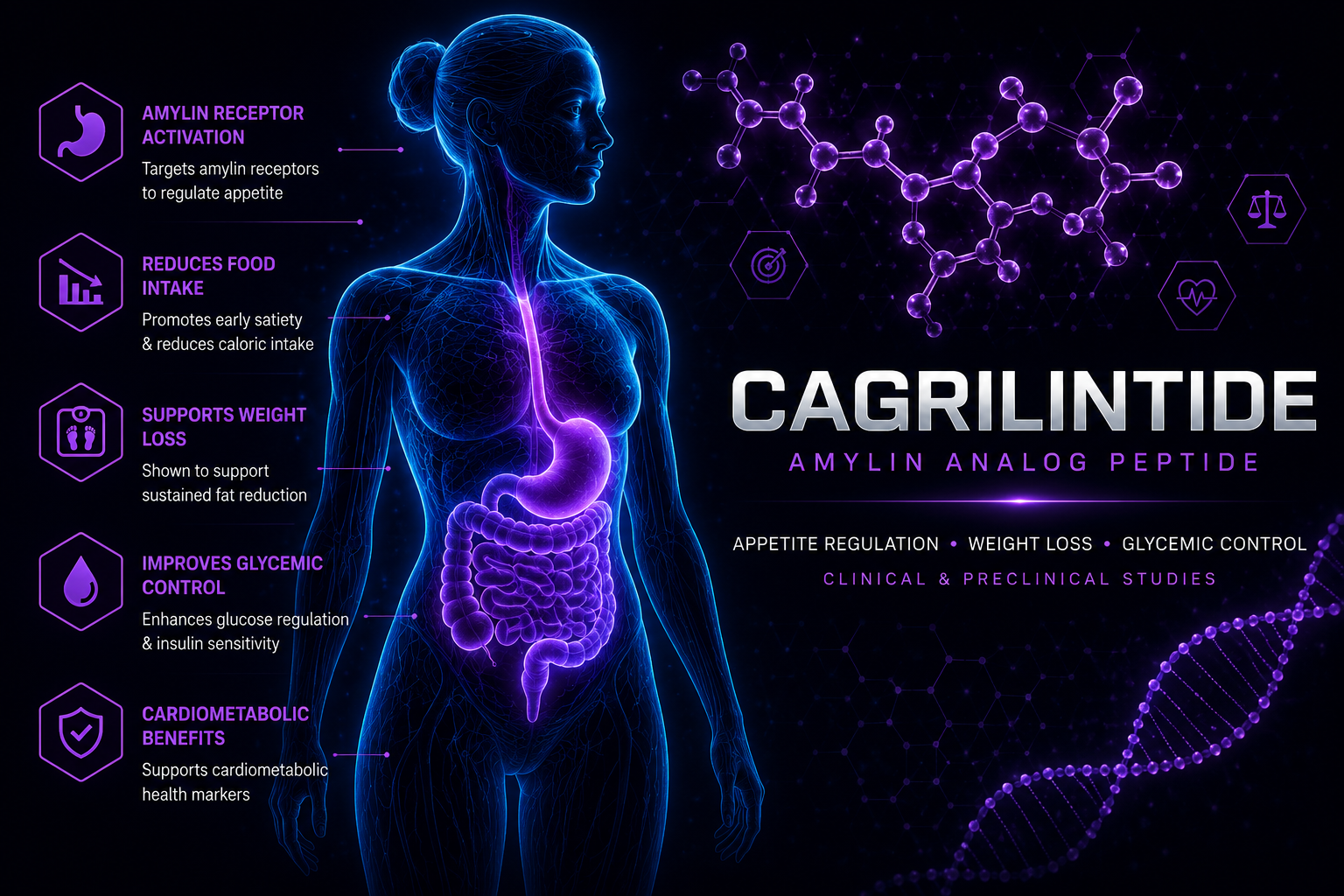
Cagrilintide is a long-acting amylin receptor agonist currently being investigated for its effects on appetite regulation, energy balance, and metabolic health. By mimicking the actions of the naturally occurring hormone amylin, Cagrilintide influences satiety signaling, gastric emptying, and food intake through central and peripheral pathways. As one of the most extensively studied next-generation amylin analogs, Cagrilintide continues to demonstrate promising potential across both clinical and preclinical research involving obesity, weight management, and metabolic disease.

Research Snapshot

CATEGORY

Metabolic Research

Mechanism

Amylin Receptor Agonist

Research

Clinical & Preclinical

Primary Focus

Appetite Regulation & Satiety

Cagrilintide Overview

Cagrilintide is a long-acting amylin receptor agonist designed to mimic the actions of the naturally occurring hormone amylin, which is co-secreted with insulin by pancreatic beta cells. By activating amylin receptors within the central nervous system and gastrointestinal tract, Cagrilintide regulates appetite, promotes satiety, and influences energy balance, making it one of the most extensively studied amylin analogs in obesity and metabolic research.

Unlike therapies that target a single incretin pathway, Cagrilintide works through the amylin signaling system to enhance feelings of fullness, slow gastric emptying, and reduce caloric intake. Clinical and preclinical studies have demonstrated significant effects on body weight reduction and metabolic regulation, generating considerable scientific interest in its potential role both as a standalone therapy and in combination with GLP-1 receptor agonists for obesity and metabolic disease research.

Current research continues to investigate Cagrilintide’s pharmacology, receptor signaling, long-term safety profile, and potential applications across obesity, metabolic disorders, appetite regulation, and combination peptide therapies. As with all compounds featured in the ChoicePeps Research Library, Cagrilintide is presented for educational and scientific reference purposes only.

Research Highlights

THE LANCET

Landmark Phase II Clinical Trial Demonstrating Significant Weight Reduction With Cagrilintide Through Long-Acting Amylin Receptor Agonism In Adults With Overweight And Obesity.

NEW ENGLAND JOURNAL OF MEDICINE

Clinical Research Evaluating Combined Cagrilintide And Semaglutide Therapy, Demonstrating Enhanced Weight Loss And Improved Metabolic Outcomes Compared With Individual Treatment.

NATURE REVIEWS ENDOCRINOLOGY

Comprehensive Review Examining Amylin Biology, Appetite Regulation, Satiety Signaling, And The Therapeutic Potential Of Next-Generation Amylin Analogs Including Cagrilintide.

DIABETES, OBESITY & METABOLISM

Current Clinical Research Summarizing Cagrilintide's Effects On Appetite Regulation, Gastric Emptying, Body Weight Reduction, And Long-Term Metabolic Health.

Research Applications

Current preclinical and clinical research is investigating Cagrilintide across several important areas of appetite regulation, amylin biology, obesity, and metabolic health.

🧠
Appetite Regulation
  • Satiety signaling
  • Appetite suppression
  • Central amylin pathways
  • Energy balance
🍽️
Weight Management
  • Body weight reduction
  • Reduced caloric intake
  • Long-term weight control
  • Body composition research
🩸
Metabolic Health
  • Glucose metabolism
  • Insulin sensitivity
  • Metabolic biomarkers
  • Overall metabolic function
🍃
Digestive Physiology
  • Gastric emptying
  • Gastrointestinal signaling
  • Nutrient absorption research
  • Postprandial metabolism
🔬
Future Clinical Research
  • Combination peptide therapy
  • Long-term obesity research
  • Metabolic disorders
  • Cardiometabolic outcomes
📈
Ongoing Investigation
  • Long-term safety evaluation
  • Amylin receptor signaling
  • Combination with GLP-1 agonists
  • Weight maintenance research

— FAQ

Questions, answered.

If you don’t see what you’re looking for, reach our team directly — usually under 24 hours.
01What is Cagrilintide

Cagrilintide is a long-acting amylin receptor agonist designed to mimic the naturally occurring hormone amylin, which is co-secreted with insulin by pancreatic beta cells. It plays an important role in regulating appetite, satiety, gastric emptying, and energy balance, making it an important investigational compound in obesity and metabolic research.

Cagrilintide activates amylin receptors located within the central nervous system and gastrointestinal tract. This signaling promotes feelings of fullness, slows gastric emptying, reduces food intake, and helps regulate energy balance. Unlike incretin-based therapies, Cagrilintide primarily works through the amylin signaling pathway to influence appetite and body weight regulation.

Researchers are interested in Cagrilintide because of its ability to produce sustained appetite suppression and significant body weight reduction through amylin receptor activation. Clinical studies have demonstrated promising effects on satiety, caloric intake, and metabolic health, while combination therapy with GLP-1 receptor agonists has shown even greater potential for obesity research.

Cagrilintide has been evaluated in multiple Phase I and Phase II clinical studies published in leading medical journals, including The Lancet. Research has examined its effects on body weight reduction, appetite regulation, metabolic outcomes, and combination therapy with semaglutide for obesity management and metabolic disease research.

Cagrilintide primarily targets amylin receptors, which are located in regions of the brain involved in appetite regulation as well as throughout the gastrointestinal system. Activation of these receptors helps coordinate satiety signaling, gastric motility, and overall energy homeostasis.

Cagrilintide has not received FDA approval as a standalone therapeutic product. It continues to be evaluated in ongoing clinical research, including studies investigating its use both alone and in combination with GLP-1 receptor agonists. The Cagrilintide featured in the ChoicePeps Research Library is presented exclusively for educational and scientific reference purposes and is intended for laboratory research only. It is not intended for human consumption or medical use.

  • Cagrilintide has not received FDA approval as a standalone therapeutic product. It continues to be evaluated in ongoing clinical research, including studies investigating its use both alone and in combination with GLP-1 receptor agonists. The Cagrilintide featured in the ChoicePeps Research Library is presented exclusively for educational and scientific reference purposes and is intended for laboratory research only. It is not intended for human consumption or medical use.

⚠️ Scientific Disclaimer

The information presented in the ChoicePeps Research Library is provided solely for educational and informational purposes. Content is compiled from publicly available scientific literature and is intended to summarize current areas of research involving investigational compounds.

The material presented on this page has not been evaluated by the U.S. Food and Drug Administration (FDA) and should not be interpreted as medical advice, treatment recommendations, or evidence of clinical efficacy. Scientific understanding continues to evolve as additional laboratory and clinical research becomes available.

ChoicePeps does not make claims regarding the diagnosis, treatment, cure, or prevention of any disease. Visitors are encouraged to consult original peer-reviewed publications when reviewing scientific findings.

FOR RESEARCH USE ONLY

Products offered by ChoicePeps are intended exclusively for legitimate laboratory and scientific research. They are not intended for human or veterinary use, and they are not intended for use in the diagnosis, treatment, cure, or prevention of any disease.