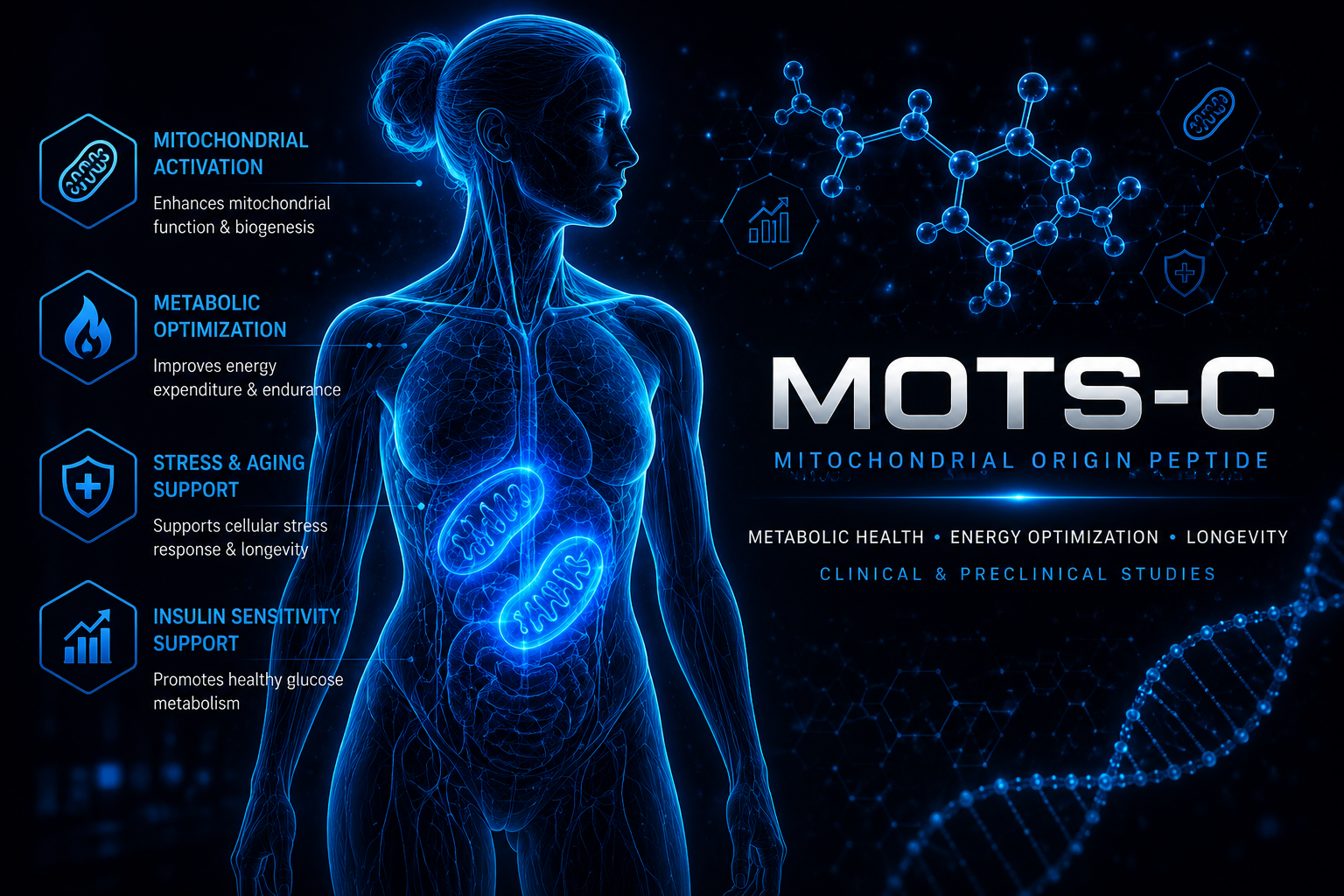
MOTS-c is a naturally occurring mitochondrial-derived peptide currently being investigated for its role in cellular energy metabolism, metabolic regulation, and mitochondrial function. By influencing key metabolic signaling pathways involved in glucose utilization, insulin sensitivity, and cellular stress responses, MOTS-c supports research into healthy aging, exercise physiology, and overall metabolic resilience. As one of the most extensively studied mitochondrial peptides, MOTS-c continues to demonstrate promising potential across both preclinical and emerging clinical research..
Mitochondrial Research
Mitochondrial-Derived Peptide
Clinical & Preclinical
Cellular Energy & Metabolism
MOTS-c is a naturally occurring mitochondrial-derived peptide encoded within mitochondrial DNA that plays an important role in cellular energy regulation and metabolic homeostasis. Rather than acting through traditional hormone receptors, MOTS-c influences intracellular signaling pathways involved in glucose metabolism, insulin sensitivity, and mitochondrial function, making it one of the most extensively studied mitochondrial peptides in metabolic and aging research.
Unlike many peptide compounds that target a single receptor or endocrine pathway, MOTS-c functions as a cellular metabolic regulator by promoting adaptive responses to metabolic stress. Research has demonstrated its potential to enhance glucose utilization, improve insulin sensitivity, support mitochondrial efficiency, and maintain metabolic flexibility. Preclinical studies have generated significant scientific interest in its potential role in exercise physiology, healthy aging, and age-related metabolic decline.
Current research continues to investigate MOTS-c’s molecular signaling pathways, mitochondrial biology, long-term safety profile, and potential applications across metabolic disease, obesity, exercise performance, healthy aging, and cellular resilience. As with all compounds featured in the ChoicePeps Research Library, MOTS-c is presented for educational and scientific reference purposes only.
Landmark Study Identifying MOTS-c As A Mitochondrial-Derived Peptide That Promotes Metabolic Homeostasis, Improves Insulin Sensitivity, And Reduces Obesity In Preclinical Models.
Comprehensive Review Examining MOTS-c's Role In Skeletal Muscle, Fat Metabolism, Mitochondrial Signaling, And Cellular Energy Regulation.
Comprehensive Review Exploring MOTS-c's Effects On Glucose Metabolism, Healthy Aging, Exercise Physiology, And Mitochondrial Communication Pathways.
Current Research Summarizing MOTS-c's Mechanisms In Energy Metabolism, AMPK Activation, Stress Response, Insulin Resistance, And Age-Related Metabolic Disease.
Current preclinical and clinical research is investigating MOTS-c across several important areas of mitochondrial biology, cellular metabolism, energy regulation, and healthy aging science.
MOTS-c is a naturally occurring mitochondrial-derived peptide encoded within mitochondrial DNA. It functions as a metabolic signaling molecule that helps regulate cellular energy balance, glucose metabolism, and stress responses. As one of the first mitochondrial peptides shown to influence whole-body metabolism, MOTS-c has become an important area of investigation in metabolic and aging research.
Unlike traditional peptide hormones that bind to cell surface receptors, MOTS-c acts as an intracellular signaling molecule. It influences key metabolic pathways, including AMP-activated protein kinase (AMPK), to promote glucose utilization, improve insulin sensitivity, support mitochondrial function, and enhance cellular adaptation during metabolic stress.
Researchers are interested in MOTS-c because it appears to function as a communication signal between mitochondria and the cell nucleus, helping coordinate energy metabolism and cellular stress responses. Preclinical studies suggest it may support metabolic flexibility, improve mitochondrial efficiency, and contribute to healthy aging, making it a promising target for metabolic and age-related research.
Since its discovery in 2015, MOTS-c has been the subject of numerous preclinical studies and scientific reviews published in journals including Cell Metabolism, Frontiers in Endocrinology, and the Journal of Translational Medicine. Research has explored its effects on glucose metabolism, insulin sensitivity, exercise physiology, mitochondrial biology, and age-related metabolic decline.
MOTS-c influences several important metabolic signaling pathways, including AMPK activation, glucose metabolism, mitochondrial stress responses, and cellular energy homeostasis. These pathways help regulate nutrient utilization, mitochondrial function, metabolic flexibility, and adaptive cellular responses under physiologic stress.
MOTS-c has not been approved by the U.S. Food and Drug Administration (FDA) for therapeutic use. The MOTS-c featured in the ChoicePeps Research Library is presented exclusively for educational and scientific reference purposes and is intended for laboratory research only. It is not intended for human consumption or medical use.
Current research continues to investigate MOTS-c’s role in mitochondrial signaling, energy metabolism, insulin sensitivity, exercise physiology, healthy aging, metabolic disorders, and cellular resilience. Ongoing studies are also exploring its effects on mitochondrial communication, metabolic adaptation, and long-term metabolic health in both preclinical and emerging clinical research.
The information presented in the ChoicePeps Research Library is provided solely for educational and informational purposes. Content is compiled from publicly available scientific literature and is intended to summarize current areas of research involving investigational compounds.
The material presented on this page has not been evaluated by the U.S. Food and Drug Administration (FDA) and should not be interpreted as medical advice, treatment recommendations, or evidence of clinical efficacy. Scientific understanding continues to evolve as additional laboratory and clinical research becomes available.
ChoicePeps does not make claims regarding the diagnosis, treatment, cure, or prevention of any disease. Visitors are encouraged to consult original peer-reviewed publications when reviewing scientific findings.
Added to cart
Check out our shop to see what's available