FREE SHIPPING ON ORDERS OVER $99
SECURE CREDIT / DEBIT CARD CHECKOUT
3RD PARTY LAB TESTED - COA AVAILABLE
FOR RESEARCH USE ONLY
SHIPS WITHIN 24 HOURS
JOIN OUR DISCORD FOR GIVEAWAYS!
QUALITY YOU AN TRUST

FREE SHIPPING ON ORDERS OVER $99
SECURE CREDIT / DEBIT CARD CHECKOUT
3RD PARTY LAB TESTED - COA AVAILABLE
FOR RESEARCH USE ONLY
SHIPS WITHIN 24 HOURS
JOIN OUR DISCORD FOR GIVEAWAYS!
QUALITY YOU AN TRUST

—PEER-REVIEWED RESEARCH

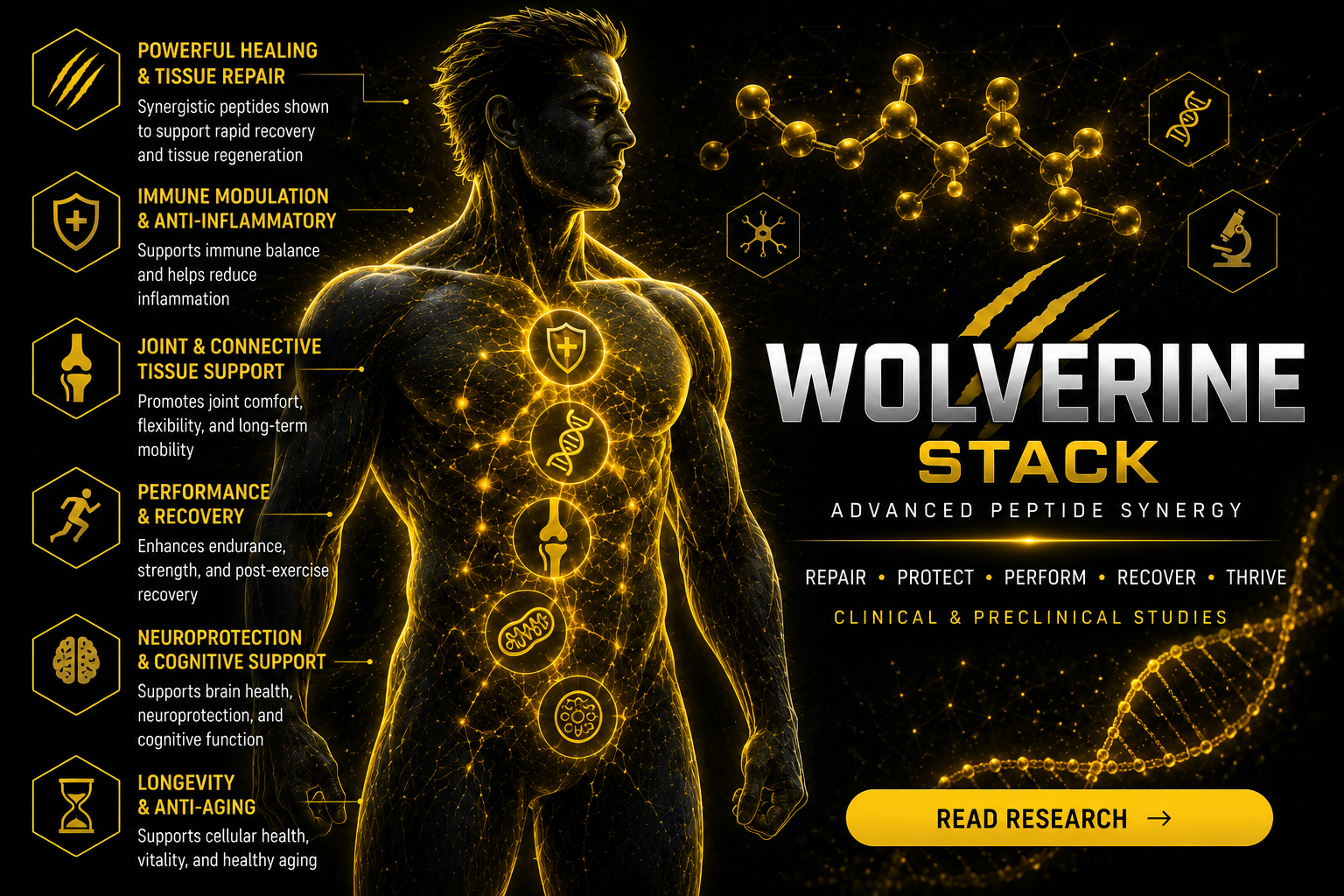
Wolverine Stack Advanced Regenerative Research

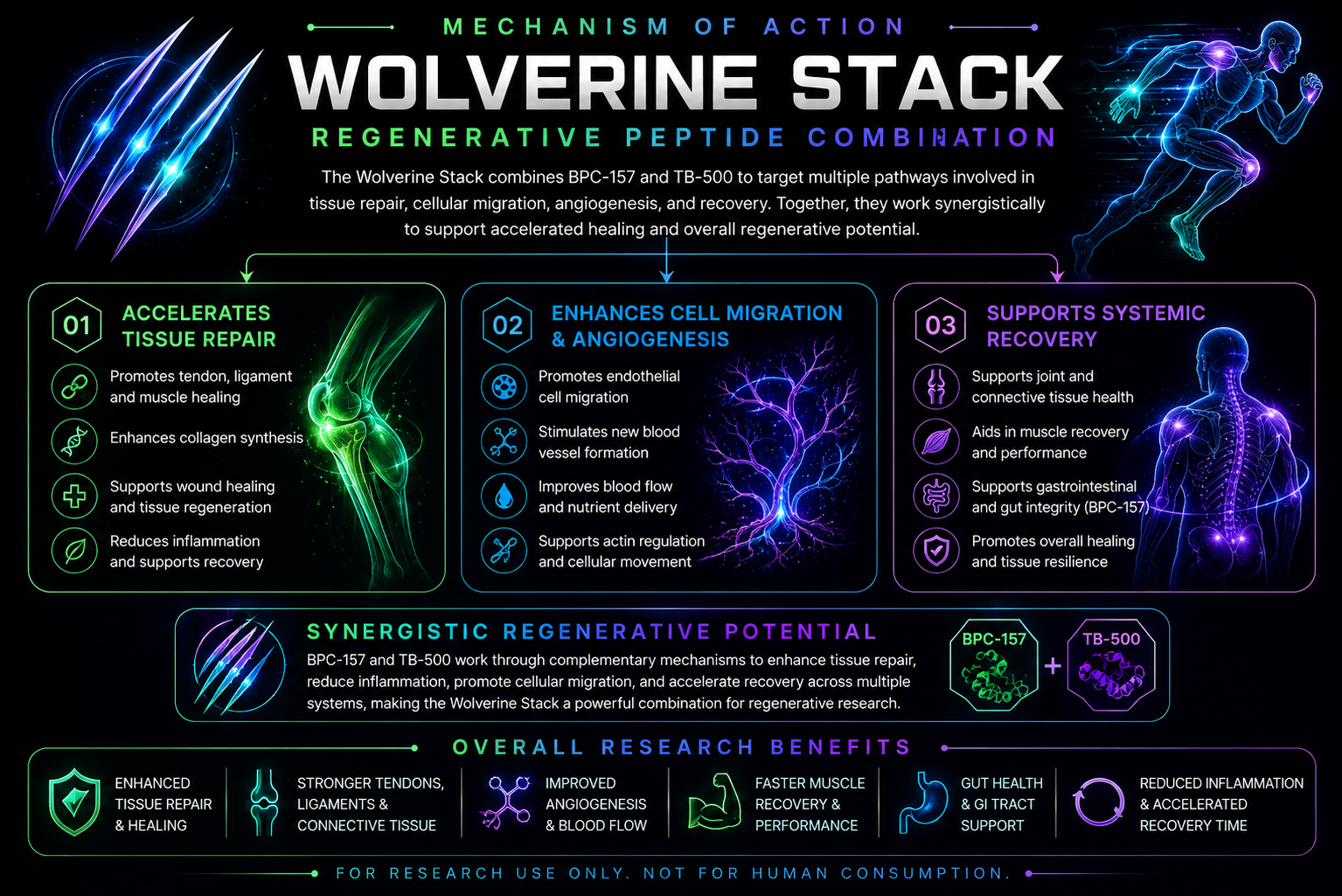
The Wolverine Stack combines two of the most extensively researched regenerative peptides—BPC-157 and TB-500—to investigate complementary mechanisms involved in tissue repair, cellular migration, angiogenesis, and recovery biology. While BPC-157 is primarily studied for localized tissue healing and gastrointestinal integrity, TB-500 is recognized for its role in actin regulation, cell migration, and systemic tissue regeneration.

Together, these peptides are being investigated across both preclinical and emerging clinical research for their potential synergistic effects on musculoskeletal recovery, tendon and ligament repair, wound healing, inflammation, and overall tissue regeneration. The Wolverine Stack continues to attract significant scientific interest as a combination strategy for studying complex healing processes and regenerative medicine.

Research Snapshot

CATEGORY

Regenerative Research

Mechanism

BPC-157 + TB-500 Peptide Combination

Research

Clinical & Preclinical

Primary Focus

Tissue Repair & Recovery

Wolverine Stack Overview

The Wolverine Stack combines BPC-157 and TB-500, two regenerative peptides that are extensively investigated for their complementary roles in tissue repair, wound healing, angiogenesis, and musculoskeletal recovery. Rather than acting through a single biological pathway, the combination targets multiple regenerative processes involved in cellular migration, collagen organization, inflammation modulation, and tissue remodeling, making it one of the most widely studied peptide stacks in regenerative research.

BPC-157 is primarily researched for its effects on tendon, ligament, muscle, nerve, and gastrointestinal tissue repair, while TB-500 is investigated for its ability to promote cell migration, actin regulation, angiogenesis, and systemic healing responses. Together, these peptides are believed to provide complementary regenerative activity, generating significant scientific interest in their combined potential for accelerating recovery and improving tissue regeneration in preclinical models.

Current research continues to investigate the Wolverine Stack across tendon and ligament injuries, muscle recovery, wound healing, orthopedic applications, inflammatory regulation, and regenerative medicine. As with all compounds featured in the ChoicePeps Research Library, the Wolverine Stack is presented exclusively for educational and scientific reference purposes and is not intended for human consumption.

Research Highlights

CELLULAR & MOLECULAR LIFE SCIENCES

Landmark Research Demonstrating BPC-157's Effects On Tendon, Ligament, Muscle, And Gastrointestinal Tissue Healing Through Angiogenesis, Collagen Organization, And Cellular Repair Mechanisms.

INTERNATIONAL JOURNAL OF MOLECULAR SCIENCES

Comprehensive Review Examining TB-500 (Thymosin β4) And Its Role In Cell Migration, Actin Regulation, Wound Healing, Tissue Regeneration, And Anti-Inflammatory Signaling Across Multiple Organ Systems.

FRONTIERS IN PHARMACOLOGY

Peer-Reviewed Research Exploring The Complementary Mechanisms Of BPC-157 And TB-500 In Musculoskeletal Recovery, Connective Tissue Repair, Angiogenesis, And Regenerative Medicine Applications.

JOURNAL OF ORTHOPAEDIC RESEARCH

Current Research Investigating Regenerative Peptide Therapies For Tendon Injuries, Ligament Healing, Skeletal Muscle Recovery, Soft Tissue Regeneration, And Long-Term Functional Recovery Following Injury.

Research Applications

Current preclinical and clinical research is investigating the Wolverine Stack across several important areas of regenerative medicine, tissue repair, musculoskeletal recovery, angiogenesis, and cellular healing biology.

🦴
Tissue Repair
  • Tendon healing
  • Ligament regeneration
  • Muscle repair
  • Collagen organization
🩹
Wound Healing
  • Accelerated tissue regeneration
  • Soft tissue recovery
  • Skin healing research
  • Post-injury repair
🩸
Angiogenesis
  • Blood vessel formation
  • Improved tissue perfusion
  • Nutrient delivery
  • Microvascular regeneration
💪
Musculoskeletal Recovery
  • Joint recovery
  • Connective tissue support
  • Exercise recovery research
  • Orthopedic applications
🔬
Future Clinical Research
  • Regenerative medicine
  • Sports medicine research
  • Orthopedic healing
  • Combination peptide therapy
📈
Ongoing Investigation
  • Long-term safety evaluation
  • Cell migration signaling
  • Inflammation modulation
  • Tissue regeneration outcomes

— FAQ

Questions, answered.

If you don’t see what you’re looking for, reach our team directly — usually under 24 hours.
01What is the Wolverine Stack

The Wolverine Stack is a research combination consisting of BPC-157 and TB-500, two peptides that have been extensively investigated for their complementary roles in tissue repair, wound healing, angiogenesis, and musculoskeletal recovery. Researchers study the combination because each peptide influences different biological pathways involved in regeneration and cellular repair.

The Wolverine Stack combines two distinct regenerative mechanisms. BPC-157 is primarily studied for its effects on tendon, ligament, muscle, nerve, and gastrointestinal tissue repair, while TB-500 is investigated for its ability to promote cell migration, angiogenesis, actin regulation, and systemic healing. Together, they are believed to support multiple stages of the body’s natural repair processes.

Researchers are interested in the Wolverine Stack because combining BPC-157 and TB-500 may provide complementary regenerative effects beyond those observed when each peptide is studied individually. Current research continues to explore their potential roles in connective tissue repair, wound healing, orthopedic recovery, and regenerative medicine.

Although relatively few studies investigate the Wolverine Stack as a specific combination, extensive preclinical research has been published on both BPC-157 and TB-500 individually. Scientific literature includes studies on tendon and ligament healing, muscle recovery, angiogenesis, inflammation, cellular migration, gastrointestinal tissue repair, and regenerative biology.

Current research focuses on tendon, ligament, skeletal muscle, connective tissue, skin, bone, peripheral nerves, blood vessels, and gastrointestinal tissues. Investigators continue to examine how the combination may influence tissue regeneration, collagen organization, and overall recovery following injury.

No. The Wolverine Stack is not approved by the U.S. Food and Drug Administration (FDA) for the diagnosis, treatment, cure, or prevention of any disease. Within the ChoicePeps Research Library, it is presented exclusively for educational and scientific reference purposes and is not intended for human consumption.

  • Ongoing research is investigating the Wolverine Stack across regenerative medicine, orthopedic healing, sports medicine, wound repair, angiogenesis, inflammation modulation, connective tissue biology, and long-term tissue regeneration. Additional studies continue to evaluate its mechanisms of action, safety profile, and potential future research applications.

⚠️ Scientific Disclaimer

The information presented in the ChoicePeps Research Library is provided solely for educational and informational purposes. Content is compiled from publicly available scientific literature and is intended to summarize current areas of research involving investigational compounds.

The material presented on this page has not been evaluated by the U.S. Food and Drug Administration (FDA) and should not be interpreted as medical advice, treatment recommendations, or evidence of clinical efficacy. Scientific understanding continues to evolve as additional laboratory and clinical research becomes available.

ChoicePeps does not make claims regarding the diagnosis, treatment, cure, or prevention of any disease. Visitors are encouraged to consult original peer-reviewed publications when reviewing scientific findings.

FOR RESEARCH USE ONLY

Products offered by ChoicePeps are intended exclusively for legitimate laboratory and scientific research. They are not intended for human or veterinary use, and they are not intended for use in the diagnosis, treatment, cure, or prevention of any disease.