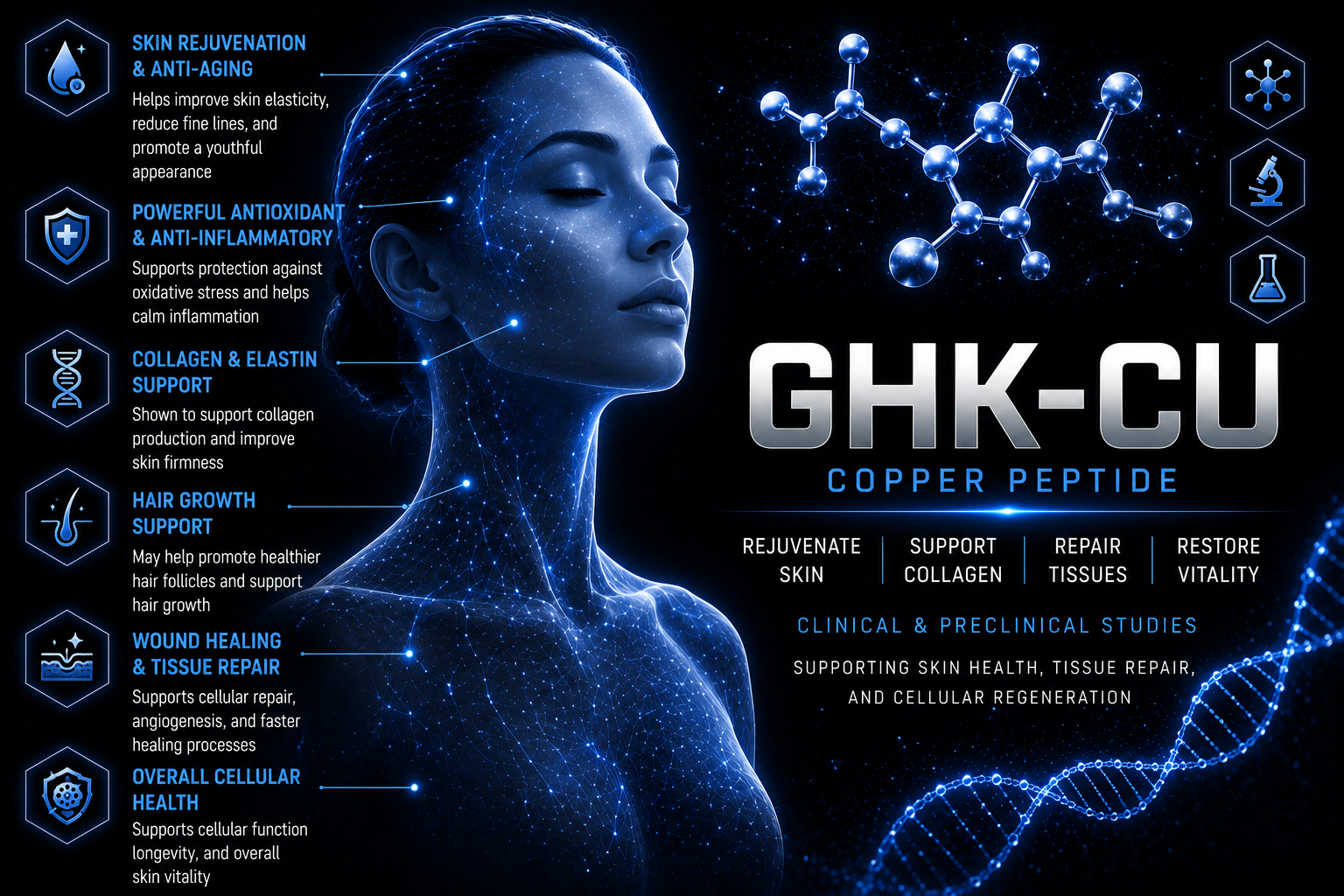
GHK-Cu (Glycyl-L-Histidyl-L-Lysine Copper) is a naturally occurring copper-binding tripeptide that has become one of the most extensively studied compounds in regenerative medicine and tissue biology. Originally identified in human plasma, GHK-Cu is known for its ability to influence wound healing, collagen synthesis, extracellular matrix remodeling, angiogenesis, and cellular repair. Its broad biological activity has generated significant scientific interest across dermatology, regenerative medicine, hair biology, and healthy aging research.
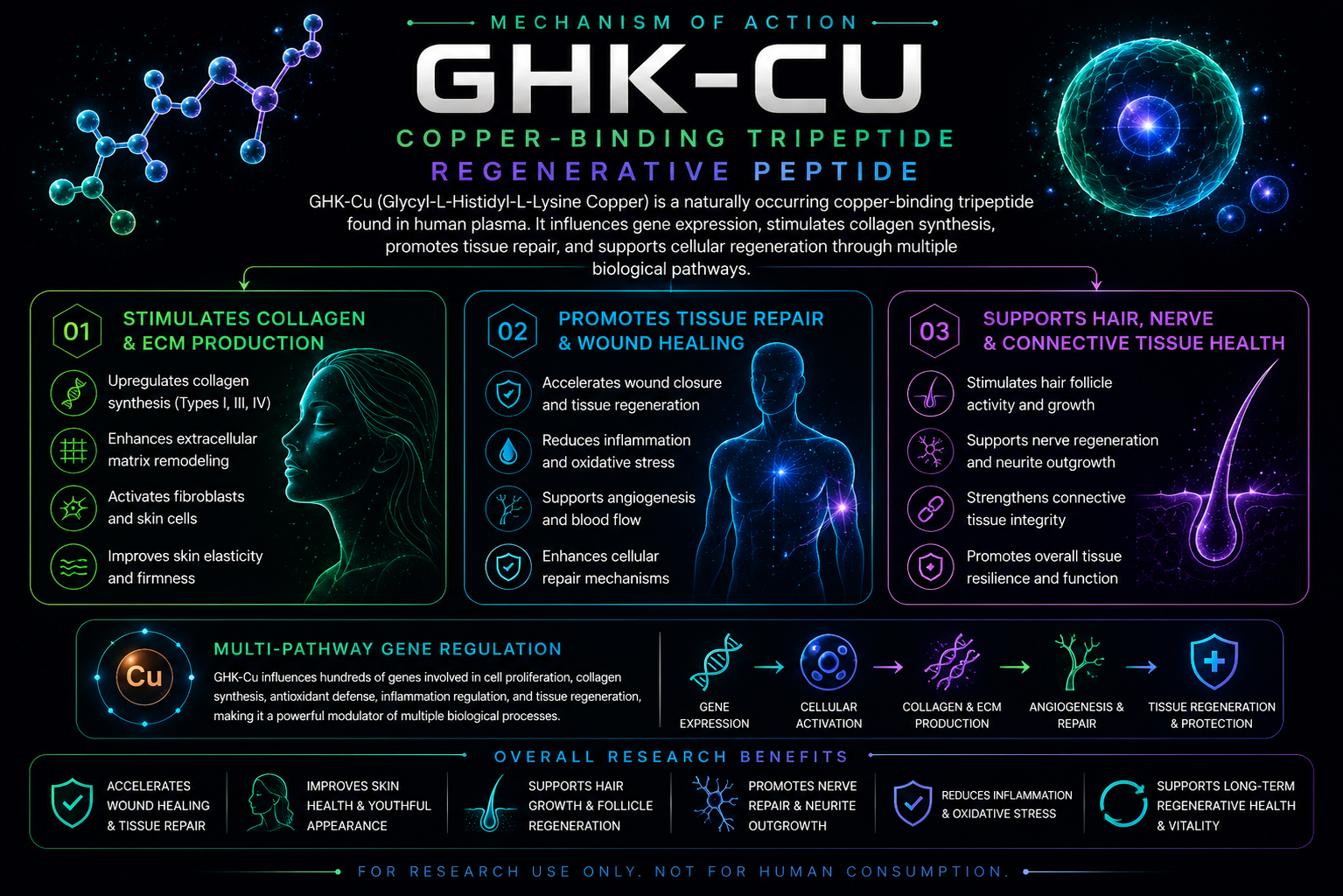
Unlike compounds that primarily target a single regenerative pathway, GHK-Cu appears to regulate hundreds of genes involved in tissue repair, inflammation, antioxidant defense, and cellular regeneration. Preclinical and clinical research has investigated its effects on skin rejuvenation, wound healing, connective tissue remodeling, hair follicle biology, nerve regeneration, and age-related changes in tissue function, making it one of the most versatile peptides currently under investigation.
As research continues to expand, investigators are evaluating GHK-Cu’s pharmacology, copper transport mechanisms, long-term safety profile, and potential applications across regenerative medicine, cosmetic science, dermatology, hair restoration, tissue engineering, and age-related physiology. As with all compounds featured in the ChoicePeps Research Library, GHK-Cu is presented exclusively for educational and scientific reference purposes and is not intended for human consumption.
Regenerative Research
Copper-Binding Tripeptide
Clinical & Preclinical
Tissue Regeneration & Skin Repair
GHK-Cu (Glycyl-L-Histidyl-L-Lysine Copper) is a naturally occurring copper-binding tripeptide that has become one of the most extensively studied peptides in regenerative medicine, tissue biology, and dermatological research. Naturally present in human plasma, saliva, and urine, GHK-Cu plays an important role in cellular repair, collagen synthesis, extracellular matrix remodeling, and wound healing. Its broad biological activity has generated significant scientific interest across skin regeneration, connective tissue repair, hair follicle biology, and healthy aging research.
Unlike compounds that target a single biological pathway, GHK-Cu appears to influence hundreds of genes involved in tissue regeneration, inflammation regulation, antioxidant defense, angiogenesis, and cellular remodeling. Clinical and preclinical research has investigated its effects on skin rejuvenation, wound healing, connective tissue repair, hair growth, nerve regeneration, and age-related tissue decline, making it one of the most versatile regenerative peptides currently under investigation.
Current research continues to evaluate GHK-Cu’s pharmacology, copper transport mechanisms, long-term safety profile, and potential applications across regenerative medicine, cosmetic science, dermatology, tissue engineering, hair restoration, and healthy aging. As with all compounds featured in the ChoicePeps Research Library, GHK-Cu is presented exclusively for educational and scientific reference purposes and is not intended for human consumption.
Landmark Research Demonstrating GHK-Cu's Ability To Stimulate Collagen Production, Improve Skin Remodeling, Accelerate Wound Healing, And Support Extracellular Matrix Regeneration Through Copper-Dependent Cellular Pathways.
Comprehensive Research Investigating GHK-Cu's Effects On Gene Expression, Copper Transport, Antioxidant Activity, Tissue Regeneration, And Cellular Repair Across Multiple Biological Systems.
Current Research Examining GHK-Cu's Role In Skin Regeneration, Hair Follicle Biology, Angiogenesis, Connective Tissue Remodeling, Nerve Repair, And Inflammation Modulation.
Clinical And Preclinical Studies Evaluating GHK-Cu's Effects On Wound Closure, Tissue Remodeling, Fibroblast Activity, Collagen Organization, And Long-Term Regenerative Medicine Applications.
Current preclinical and clinical research is investigating GHK-Cu across several important areas of tissue regeneration, collagen synthesis, wound healing, skin rejuvenation, hair biology, and regenerative medicine.
GHK-Cu (Glycyl-L-Histidyl-L-Lysine Copper) is a naturally occurring copper-binding tripeptide found in human plasma, saliva, and urine. Researchers study GHK-Cu for its potential role in tissue regeneration, collagen synthesis, wound healing, skin remodeling, hair follicle biology, and healthy aging due to its broad influence on cellular repair mechanisms.
GHK-Cu binds copper ions and appears to regulate hundreds of genes involved in tissue repair, extracellular matrix remodeling, collagen production, antioxidant defense, inflammation modulation, and cellular regeneration. These coordinated biological effects make it one of the most extensively investigated regenerative peptides.
Researchers are interested in GHK-Cu because of its broad regenerative properties across multiple biological systems. Clinical and preclinical studies have explored its potential to support skin rejuvenation, wound healing, connective tissue repair, hair growth, nerve regeneration, and age-related tissue maintenance through naturally occurring repair pathways.
Numerous clinical and laboratory studies have investigated GHK-Cu’s effects on collagen synthesis, skin regeneration, wound healing, angiogenesis, hair follicle biology, antioxidant activity, connective tissue remodeling, and regenerative medicine. Ongoing research continues to evaluate its molecular mechanisms and long-term safety profile.
Current research suggests GHK-Cu influences collagen synthesis, extracellular matrix remodeling, fibroblast activation, copper transport, gene expression, antioxidant defense, angiogenesis, inflammation regulation, and cellular repair pathways that collectively support tissue regeneration.
No. GHK-Cu is not approved by the U.S. Food and Drug Administration (FDA) for the diagnosis, treatment, cure, or prevention of any disease. Within the ChoicePeps Research Library, GHK-Cu is presented exclusively for educational and scientific reference purposes and is not intended for human consumption.
Current research is investigating GHK-Cu across regenerative medicine, skin rejuvenation, collagen production, wound healing, connective tissue remodeling, hair restoration, nerve regeneration, cosmetic science, tissue engineering, and healthy aging. Additional studies continue to evaluate its long-term safety profile and potential future applications in regenerative biology.
The information presented in the ChoicePeps Research Library is provided solely for educational and informational purposes. Content is compiled from publicly available scientific literature and is intended to summarize current areas of research involving investigational compounds.
The material presented on this page has not been evaluated by the U.S. Food and Drug Administration (FDA) and should not be interpreted as medical advice, treatment recommendations, or evidence of clinical efficacy. Scientific understanding continues to evolve as additional laboratory and clinical research becomes available.
ChoicePeps does not make claims regarding the diagnosis, treatment, cure, or prevention of any disease. Visitors are encouraged to consult original peer-reviewed publications when reviewing scientific findings.
Added to cart
Check out our shop to see what's available