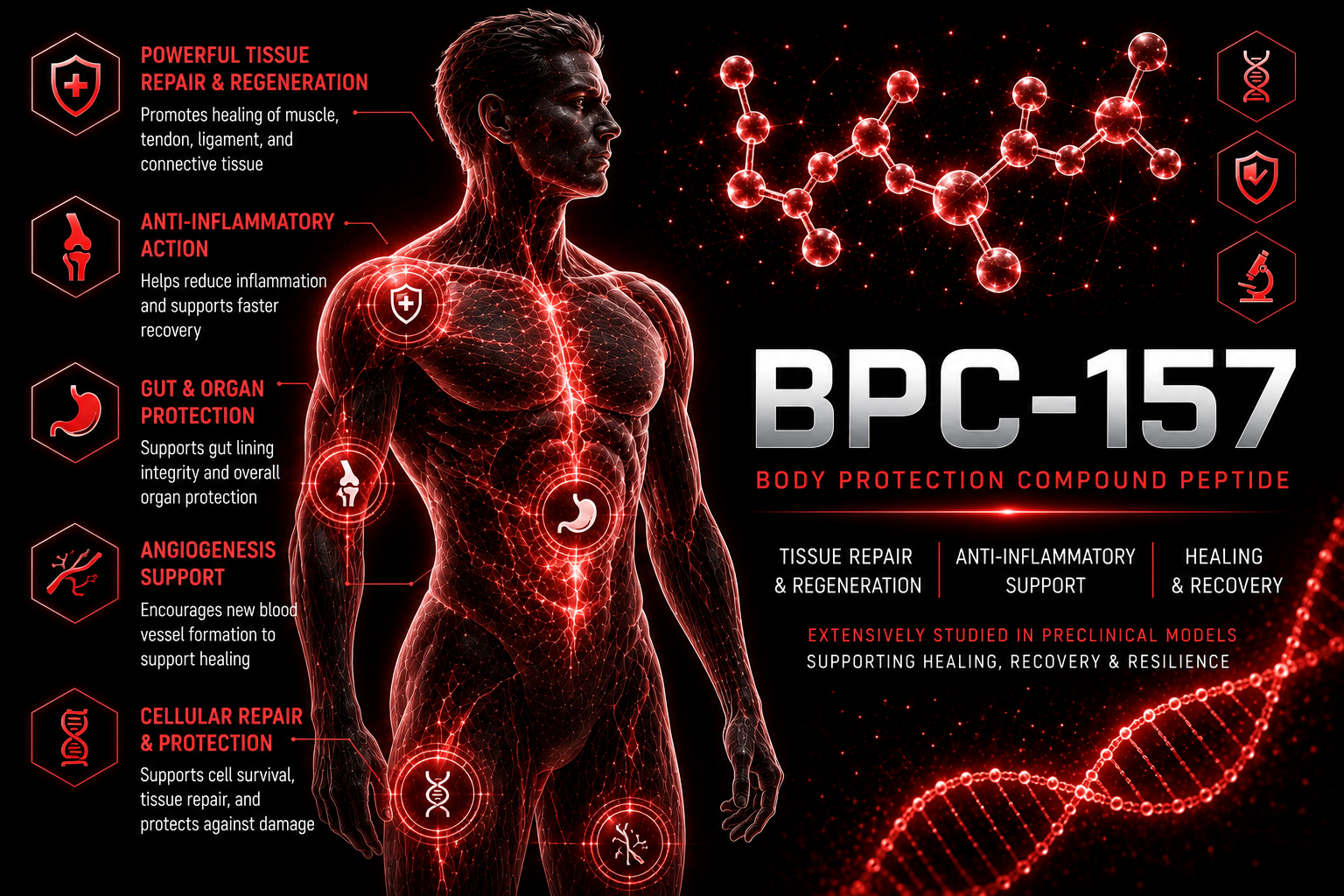
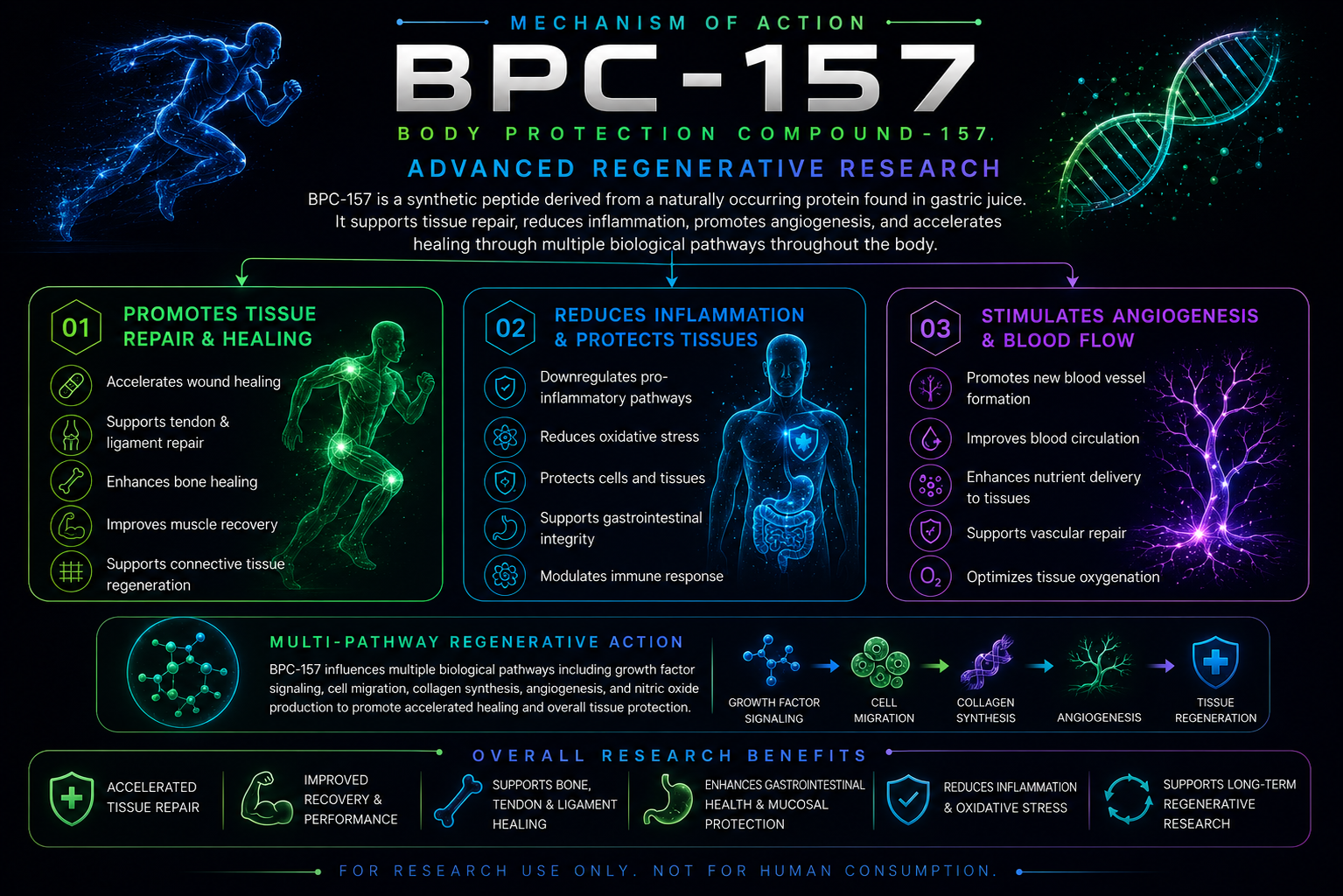
BPC-157 (Body Protection Compound-157) is a synthetic peptide derived from a naturally occurring protective protein found in gastric juice and is extensively investigated for its regenerative and tissue repair properties. Research has demonstrated its ability to influence multiple biological pathways involved in wound healing, angiogenesis, collagen organization, cellular migration, and tissue regeneration, making it one of the most widely studied peptides in regenerative medicine.
Unlike compounds that target a single repair mechanism, BPC-157 appears to coordinate several processes involved in healing and recovery. Preclinical research has explored its potential effects on tendon and ligament repair, skeletal muscle recovery, bone healing, peripheral nerve regeneration, gastrointestinal integrity, and vascular function. Its broad range of biological activity has generated significant scientific interest across orthopedic, gastrointestinal, sports medicine, and regenerative research.
As research continues to evolve, investigators are examining BPC-157’s pharmacology, mechanisms of action, long-term safety profile, and potential applications across tissue regeneration, inflammatory disorders, connective tissue healing, and recovery science. As with all compounds featured in the ChoicePeps Research Library, BPC-157 is presented exclusively for educational and scientific reference purposes and is not intended for human consumption.
Regenerative Research
Cytoprotective Peptide
Clinical & Preclinical
Tissue Repair & Healing
BPC-157 (Body Protection Compound-157) is a synthetic peptide derived from a naturally occurring protective protein found in gastric juice and has become one of the most extensively studied peptides in regenerative medicine. Research suggests that BPC-157 influences multiple biological pathways involved in tissue repair, angiogenesis, collagen organization, cellular migration, and wound healing. These diverse mechanisms have generated significant scientific interest across orthopedic, gastrointestinal, vascular, and musculoskeletal research.
Unlike compounds that primarily target a single regenerative pathway, BPC-157 appears to support several coordinated healing processes throughout the body. Preclinical studies have investigated its effects on tendon and ligament repair, skeletal muscle recovery, bone healing, peripheral nerve regeneration, gastrointestinal integrity, blood vessel formation, and connective tissue remodeling. Its broad regenerative profile continues to make it a leading investigational peptide in recovery and tissue regeneration research.
Current research continues to evaluate BPC-157’s pharmacology, mechanisms of action, long-term safety profile, and potential applications across regenerative medicine, sports medicine, gastrointestinal health, inflammatory disorders, and connective tissue healing. As with all compounds featured in the ChoicePeps Research Library, BPC-157 is presented exclusively for educational and scientific reference purposes and is not intended for human consumption.
Landmark Research Demonstrating BPC-157's Ability To Accelerate Tendon, Ligament, Muscle, Bone, And Connective Tissue Healing Through Enhanced Cellular Migration, Angiogenesis, And Collagen Organization.
Comprehensive Review Examining BPC-157's Cytoprotective Properties, Gastrointestinal Protection, Wound Healing, Vascular Biology, And Regenerative Potential Across Multiple Organ Systems.
Preclinical Research Investigating BPC-157's Effects On Tendon Healing, Ligament Repair, Musculoskeletal Recovery, Bone Regeneration, And Functional Recovery Following Injury.
https://www.mdpi.com/journal/ijms
Current preclinical and clinical research is investigating BPC-157 across several important areas of tissue regeneration, wound healing, angiogenesis, musculoskeletal recovery, gastrointestinal protection, and regenerative medicine.
BPC-157 (Body Protection Compound-157) is a synthetic peptide derived from a naturally occurring protective protein found in gastric juice. Researchers study BPC-157 for its potential role in tissue repair, angiogenesis, connective tissue regeneration, gastrointestinal protection, and musculoskeletal healing across a wide range of preclinical models.
BPC-157 appears to influence several biological pathways involved in tissue regeneration, including growth factor signaling, collagen synthesis, angiogenesis, cellular migration, and nitric oxide regulation. These coordinated mechanisms are believed to support wound healing, tissue repair, and recovery following injury.
Researchers are interested in BPC-157 because of its broad regenerative profile. Preclinical studies have demonstrated promising effects across tendon and ligament healing, muscle recovery, bone regeneration, gastrointestinal protection, peripheral nerve repair, and vascular biology, making it one of the most extensively investigated regenerative peptides.
Numerous preclinical studies have examined BPC-157’s effects on musculoskeletal injuries, wound healing, gastrointestinal disorders, vascular function, inflammation, connective tissue repair, and regenerative medicine. Ongoing research continues to investigate its mechanisms of action, pharmacology, and long-term safety profile.
Current research suggests BPC-157 influences growth factor signaling, angiogenesis, collagen organization, nitric oxide pathways, cellular migration, fibroblast activity, and tissue remodeling. These interconnected mechanisms contribute to its broad regenerative potential observed in experimental studies.
No. BPC-157 is not approved by the U.S. Food and Drug Administration (FDA) for the diagnosis, treatment, cure, or prevention of any disease. Within the ChoicePeps Research Library, BPC-157 is presented exclusively for educational and scientific reference purposes and is not intended for human consumption.
Current research is investigating BPC-157 across regenerative medicine, tendon and ligament healing, muscle recovery, bone repair, gastrointestinal health, angiogenesis, vascular biology, connective tissue regeneration, peripheral nerve repair, and inflammation modulation. Additional studies continue to evaluate its long-term safety profile and potential future research applications.
The information presented in the ChoicePeps Research Library is provided solely for educational and informational purposes. Content is compiled from publicly available scientific literature and is intended to summarize current areas of research involving investigational compounds.
The material presented on this page has not been evaluated by the U.S. Food and Drug Administration (FDA) and should not be interpreted as medical advice, treatment recommendations, or evidence of clinical efficacy. Scientific understanding continues to evolve as additional laboratory and clinical research becomes available.
ChoicePeps does not make claims regarding the diagnosis, treatment, cure, or prevention of any disease. Visitors are encouraged to consult original peer-reviewed publications when reviewing scientific findings.
Added to cart
Check out our shop to see what's available