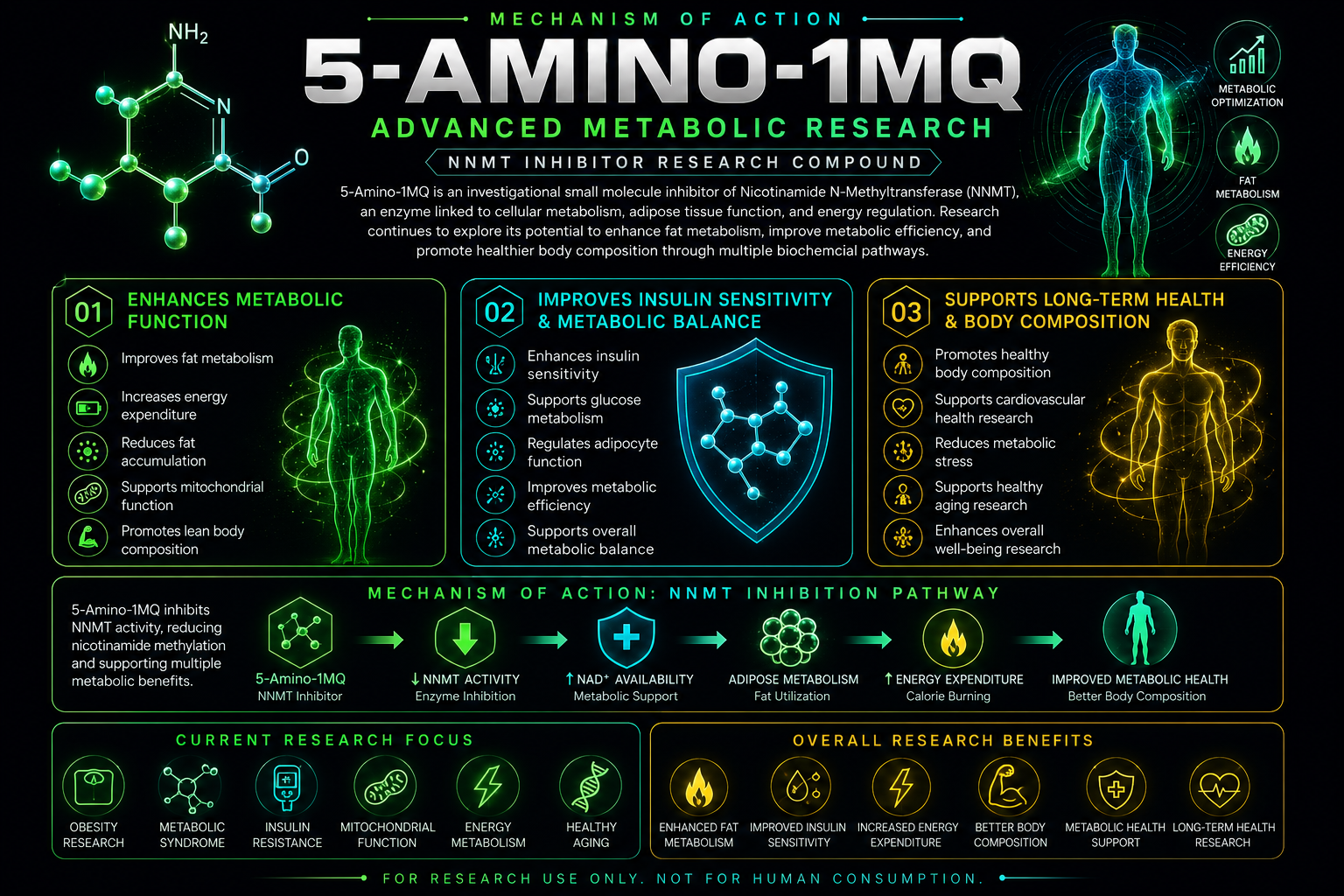
5-Amino-1MQ is an investigational small molecule being studied for its ability to inhibit Nicotinamide N-methyltransferase (NNMT), an enzyme involved in cellular metabolism, adipose tissue biology, and energy utilization. By reducing NNMT activity, researchers are investigating whether 5-Amino-1MQ may influence fat metabolism, improve metabolic efficiency, and promote healthier body composition through multiple biochemical pathways.
As one of the most promising NNMT inhibitors currently under investigation, 5-Amino-1MQ has generated growing scientific interest across both preclinical and translational research involving obesity, insulin sensitivity, energy expenditure, and metabolic health. Researchers continue to explore its potential role in regulating adipocyte function, mitochondrial activity, and whole-body energy balance while further evaluating its long-term biological mechanisms and future therapeutic applications.
Metabolic Research
NNMT Enzyme Inhibitor
Clinical & Preclinical
Fat Metabolism & Energy Balance
5-Amino-1MQ is an investigational small molecule being studied for its ability to inhibit Nicotinamide N-methyltransferase (NNMT), a metabolic enzyme that plays an important role in cellular energy regulation and adipose tissue biology. By reducing NNMT activity, researchers are investigating whether 5-Amino-1MQ may enhance fat metabolism, improve mitochondrial efficiency, and promote healthier body composition through multiple interconnected metabolic pathways.
Unlike compounds that primarily suppress appetite, 5-Amino-1MQ is being investigated for its potential to influence energy expenditure at the cellular level. Preclinical studies have demonstrated promising effects on adipocyte metabolism, fat accumulation, insulin sensitivity, and overall metabolic efficiency, generating significant scientific interest in its potential role for obesity, metabolic dysfunction, and body composition research.
Current research continues to investigate 5-Amino-1MQ across a broad range of applications including obesity, metabolic syndrome, insulin resistance, mitochondrial function, healthy aging, and energy metabolism. As with all compounds featured in the ChoicePeps Research Library, 5-Amino-1MQ is presented exclusively for educational and scientific reference purposes and is intended for research use only.
Comprehensive reviews examining NNMT biology, adipose tissue metabolism, energy homeostasis, and the molecular mechanisms underlying metabolic dysfunction relevant to 5-Amino-1MQ research.
Experimental studies investigating NNMT inhibition, mitochondrial function, insulin sensitivity, energy expenditure, and metabolic regulation across a variety of preclinical obesity models.
Current research exploring the effects of NNMT inhibition on fat metabolism, body composition, adipocyte biology, metabolic flexibility, and weight management through cellular metabolic pathways.
Peer-reviewed investigations evaluating metabolic mechanisms involving insulin sensitivity, glucose homeostasis, adipose tissue remodeling, energy utilization, and long-term metabolic health associated with NNMT research.
Current preclinical and clinical research is investigating 5-Amino-1MQ across multiple areas of metabolic regulation, NNMT inhibition, adipose tissue biology, mitochondrial function, and body composition.
5-Amino-1MQ is a small-molecule research compound that inhibits nicotinamide N-methyltransferase (NNMT), an enzyme involved in cellular metabolism and energy regulation. By reducing NNMT activity, researchers are investigating its potential effects on fat metabolism, mitochondrial function, body composition, and overall metabolic health. It is currently used exclusively in laboratory and preclinical research.
5-Amino-1MQ works by selectively inhibiting the NNMT enzyme, which plays a role in regulating cellular energy expenditure and metabolic pathways. NNMT inhibition has been shown in preclinical studies to influence NAD+ metabolism, improve metabolic efficiency, increase energy utilization, and reduce fat accumulation through multiple interconnected biological mechanisms.
Researchers are interested in 5-Amino-1MQ because NNMT has emerged as an important regulator of obesity, insulin resistance, metabolic syndrome, and healthy aging. Inhibiting this enzyme has demonstrated promising effects in laboratory models involving adipose tissue biology, mitochondrial function, body composition, and metabolic regulation.
Multiple peer-reviewed studies have investigated NNMT biology and the effects of NNMT inhibitors such as 5-Amino-1MQ. Research has explored adipocyte metabolism, obesity, energy expenditure, insulin sensitivity, mitochondrial biology, and the therapeutic potential of targeting NNMT for metabolic disease and healthy aging.
Current research suggests that 5-Amino-1MQ primarily influences pathways involved in NNMT activity, NAD+ metabolism, cellular methylation, mitochondrial energy production, lipid metabolism, and whole-body metabolic regulation. These pathways are closely associated with energy balance and body composition.
No. 5-Amino-1MQ is not FDA approved for the diagnosis, treatment, prevention, or cure of any disease. It remains an investigational research compound intended solely for laboratory and scientific research.
Current research is investigating 5-Amino-1MQ across a wide range of applications, including obesity, metabolic syndrome, insulin resistance, adipose tissue remodeling, mitochondrial function, healthy aging, and long-term metabolic health. Additional studies continue to explore optimal dosing strategies, safety profiles, and future therapeutic potential in metabolic medicine.
The information presented in the ChoicePeps Research Library is provided solely for educational and informational purposes. Content is compiled from publicly available scientific literature and is intended to summarize current areas of research involving investigational compounds.
The material presented on this page has not been evaluated by the U.S. Food and Drug Administration (FDA) and should not be interpreted as medical advice, treatment recommendations, or evidence of clinical efficacy. Scientific understanding continues to evolve as additional laboratory and clinical research becomes available.
ChoicePeps does not make claims regarding the diagnosis, treatment, cure, or prevention of any disease. Visitors are encouraged to consult original peer-reviewed publications when reviewing scientific findings.
Added to cart
Check out our shop to see what's available